
About the CEO Report
In the CEO reports, Ilia Management Consulting Company aims to provide a comprehensive analysis of organizational performance, economic and business conditions, and forecasts for the coming year by examining the concerns, approaches, lifestyles, and work styles of Iranian CEOs.
In the first edition of the CEO Report, the level of hope for the future was measured at both the macro and corporate levels, and a study of CEO lifestyles was conducted. At the end, for each finding, a description of the results and issues for future discussion and consideration was presented. It should be noted that Full text of the report It includes more details on each of the items mentioned, as well as items such as sample information, research methodology, etc., for those interested in studying. Below, we will review some of the most important results of this report.
CEOs’ views and concerns
In this section, the issue of hope for the future has been analyzed and examined at both the firm and macro levels. The results show that despite numerous issues and lack of optimism about the conditions prevailing in the macro environment of the Iranian economy, CEOs are hopeful about the performance and growth of their firms in the coming year. Economic instability was a concern of one CEO at the macro level and the area of human resources last year, and financial and investment issues were the top two concerns at the firm level this year.
Hope for economic prosperity and the state of the enterprise
The data analysis shows that despite the ambiguous conditions, over 30% of managers predicted a relative boom, and only about 2% believe in a strong economic boom. This is while more than 40% of CEOs predicted a major or relative recession for the Iranian economy in 1400, and 15% of CEOs predicted the Iranian economy in 1400 to remain unchanged compared to 2010.
60% of CEOs are hopeful about their company’s positive performance in 1400.
In the chart below, which shows optimism, CEOs who are optimistic about the firm’s performance are above the line of optimism and CEOs who are pessimistic are below it. As we move to the right of the chart, we see managers who are more optimistic about the future of the country’s economy.
The results show that young CEOs with less CEO experience are more optimistic about both the future state of Iran’s economy and the performance of their firm.
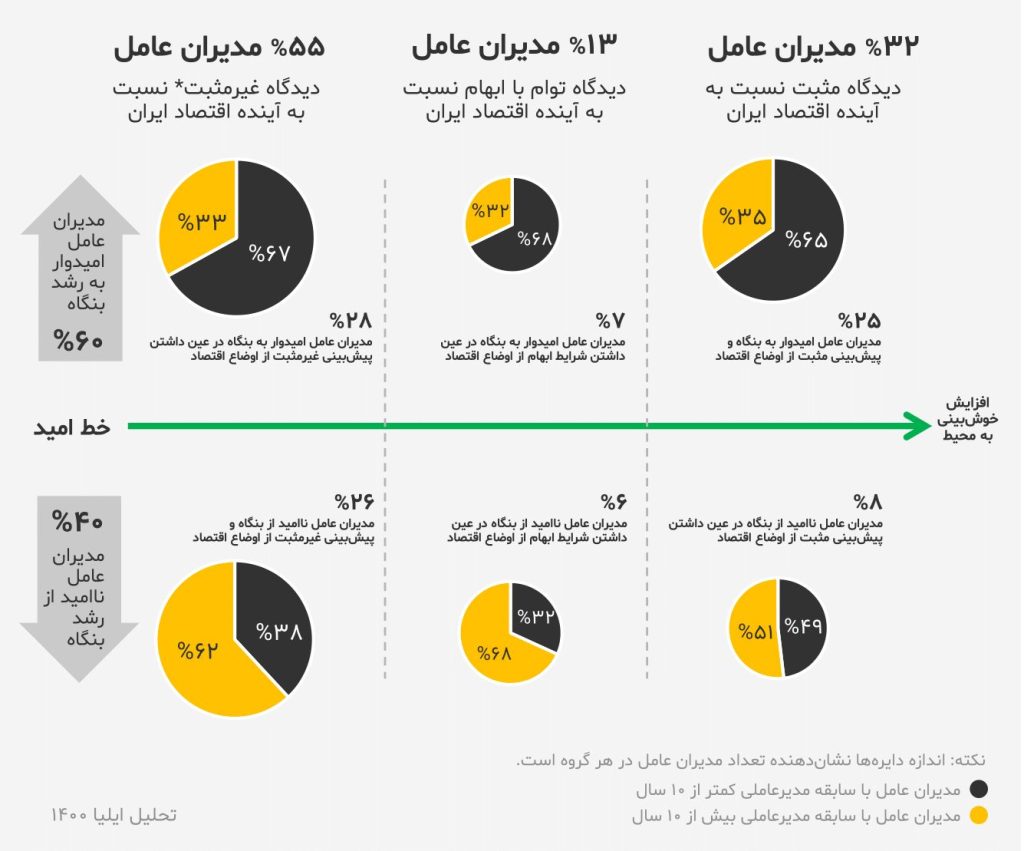
CEOs in larger firms (with an annual turnover of more than 20 billion Tomans and a size of more than 200 people) are optimistic about the environment and hopeful about the firm’s performance.
Comparison of 2020 performance and 2021 performance forecast
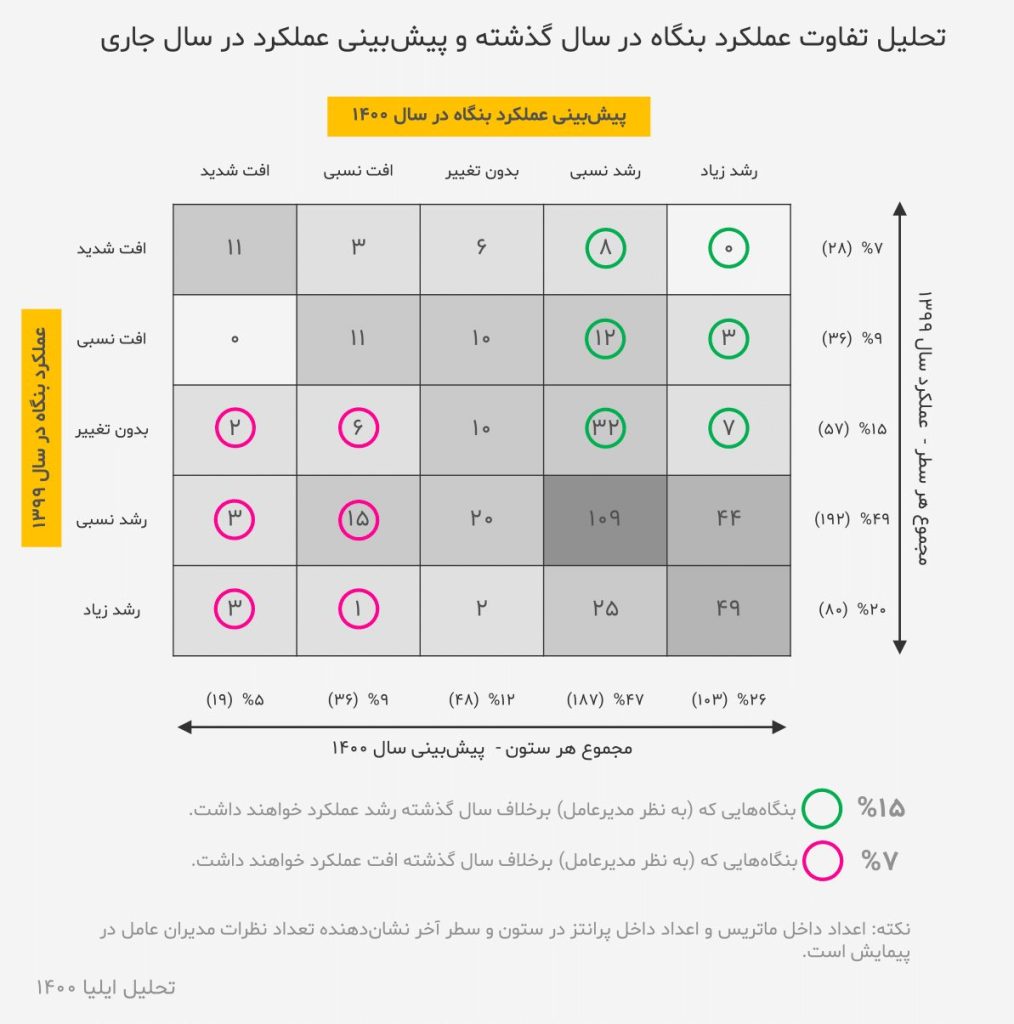
78% of CEOs believe their company’s performance will not be significantly different from last year.
Only 22% of managers believe in a significant difference (decline or growth in performance) in the company compared to last year.
CEOs’ main concerns
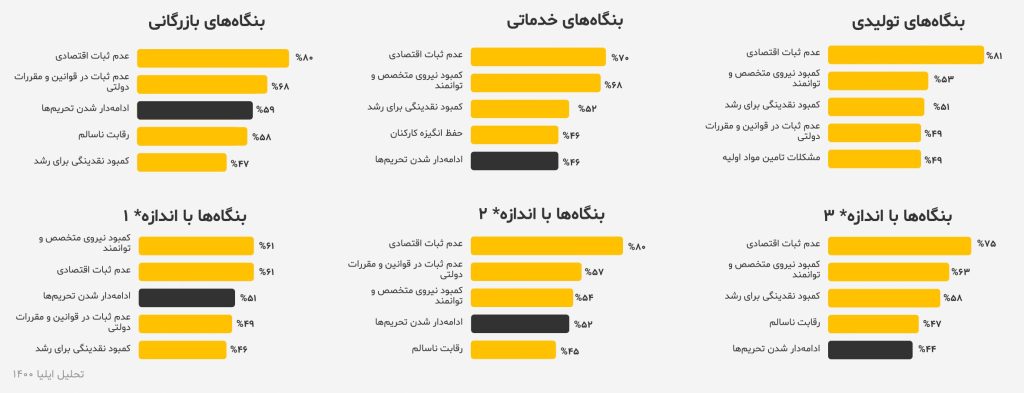
76% of CEOs cited economic instability as their top concern. The second-largest concern for CEOs is the lack of skilled and capable workforce (58%), and half of CEOs are also concerned about a lack of liquidity for their company.
The continuation of sanctions, confusion due to the lack of stability in government laws and regulations, the existence of unhealthy competition among industry players, and access to various rents are the concerns of CEOs in the next ranks. Except for CEOs of manufacturing firms, the majority of CEOs in the survey consider the continuation of sanctions to be among the top five concerns in 1400.
The most important challenge for businesses
The most internal challenges in 2020 were related to human resources. These challenges were more important for experienced CEOs. And the most important internal challenge for CEOs in 2019 was financial and investment issues.
Coronavirus and businesses
The data analysis shows that the businesses of more than half (42% relatively negative impact and 13% very negative impact) of the managers in this study have been harmed by the pandemic, while more than a quarter of the other businesses have benefited from these developments. At another level, the impact of the coronavirus was analyzed in comparison with the size of the firms, with the results showing that small and medium-sized firms suffered more serious damage than large firms, while over 35% of managers of large firms admitted that their firm experienced growth during the coronavirus outbreak.
CEOs’ lifestyle and work style
The personal and work aspects of Iranian CEOs were studied in various topics in this section. A summary of the most important topics in this section shows that Iranian CEOs are early risers, work an average of 11 hours a day, and spend 2 hours of their time on social media.
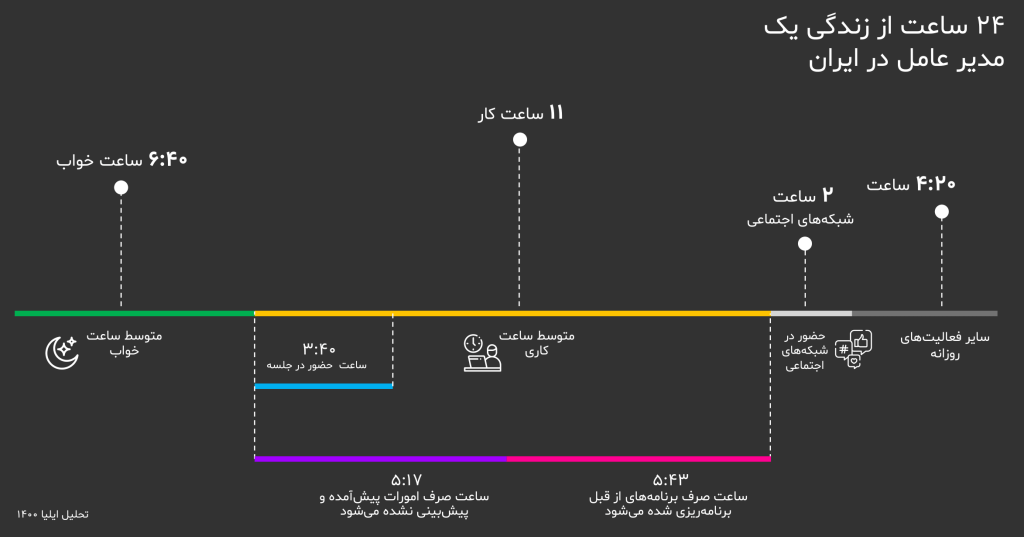
28% of CEOs live with high levels of stress on a daily basis. CEOs with good sleep quality are less likely to suffer from high levels of stress than other CEOs.
More than 40 percent of CEOs experience regular, quality sleep and maintain a healthy diet. Other CEOs’ self-care programs include periodic medical checkups, regular exercise, regular prayer and meditation.
About 40 percent of CEOs experience a good work-life balance.
More than half of CEOs use informal information and news sources to obtain information.
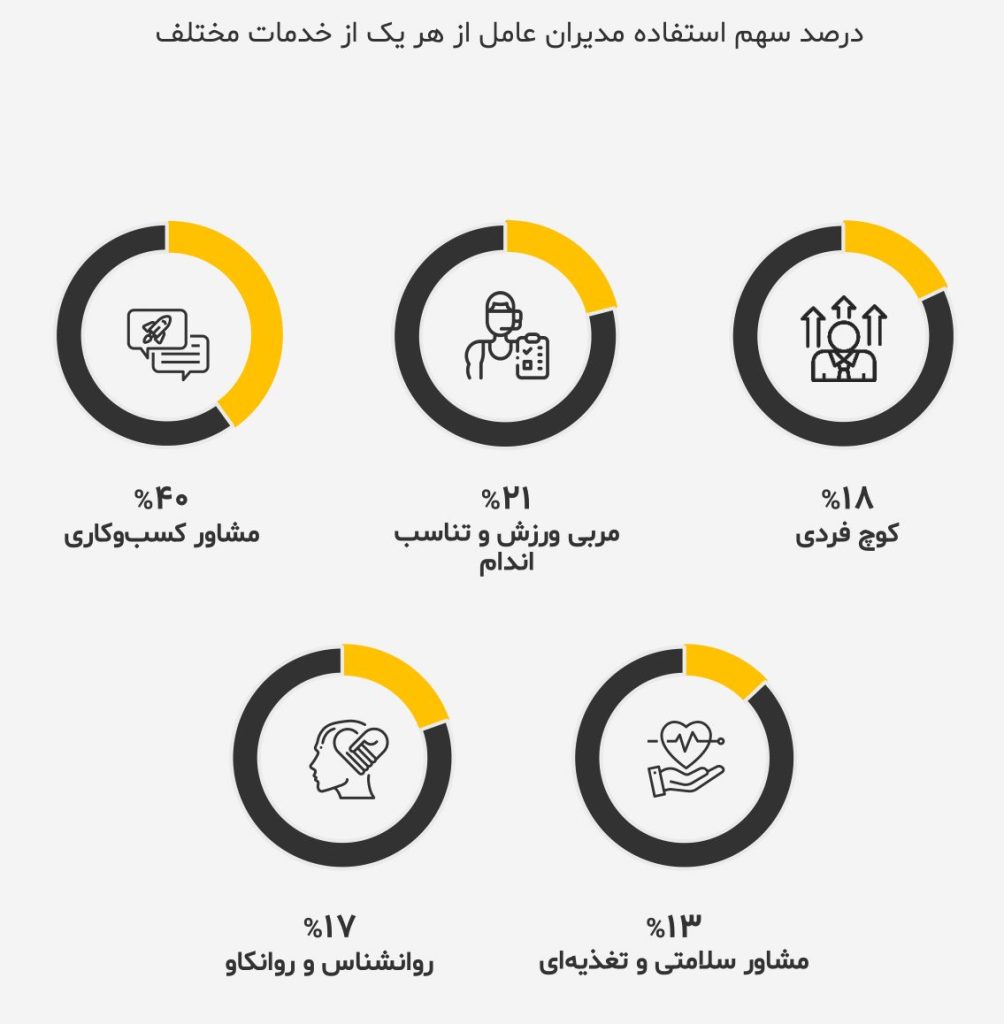
CEOs use a variety of methods and services for personal development and business growth. The amount of reading books and articles, attending training courses, and using business coaches and consultants are topics examined in this study.
Nearly 30 percent of managers spend an average of 1 to 2 hours per month on training courses and events. More than 11 percent spend between 6 and 9 hours per month on their own training. This is while 26 percent of managers in the survey do not spend any time per month on training courses.
About 40 percent of CEOs currently use the services of a business consultant in various fields. Also, 21 percent of CEOs use a sports coach for personal development and self-care.
Summarizing the results and presenting the problem to the audience
In the summary of key findings, each section of the study was addressed by audience, and for each finding, a description of the results and issues for future discussion and consideration was presented. In general, the findings of the report can be summarized into 5 issues for CEOs and 3 issues related to policymakers and business decision-makers. In the final section of the report, issues have been proposed to deepen the audience’s view of these issues and to be a start on the path to improving these results.
Problem-solving from the report findings for CEOs
Shortage of skilled workers: This result is likely to cause more concern for human resource managers. What measures can be taken in organizations to address or reduce one of the most important concerns of CEOs? What approaches can be taken to increase employee motivation, especially in the current climate of the country?
Long working hours: The importance of this finding for CEOs is associated with raising this issue; how can they better manage their time during the workday? Can a suitable solution be found to improve unplanned tasks that also require more energy and time? Among the activities that have occurred, there may be issues that can be planned and scheduled?
High stress for CEOs: The position of CEO is one of the most stressful jobs in an organization. A question that can be asked in the position of a CEO in Iran is; to what extent have CEOs in Iran equipped themselves with stress management skills?
Low use of management consulting services by CEOs: Questions that can be studied and investigated further in the future; What is the reason for the lack of trust of Iranian CEOs in management consulting services? To what extent are managers or business owners satisfied with the services they have received? And on another level, what role can management consulting companies and business consultants play in improving the quality of their services?
Decision-making based on unofficial information and news: Did this level of distrust of managers in official sources in the country to obtain first-hand information for future decisions for themselves and the organization extend to other cases and issues?
Proposing issues from the report’s findings for policymakers and decision-makers in the economic and business fields
CEOs’ pessimism about improving Iran’s economic situation: A question that can be raised from this finding is how can the hope and optimism of CEOs, who are at the helm of the country’s economic growth and development, not only be maintained but also increased by adopting better decisions and policies at the macro level?
Concerns about the instability and inefficiency of the economic situation: The question that can be raised is how to provide safe and secure conditions for Iranian CEOs to be more confident about the country’s macro situation, so that the success and failure of businesses are not subject to environmental problems and obstacles, and CEOs can focus and pay attention to their team and internal issues within their firm?
The need for greater attention to smaller businesses in times of crisis: The question that arises is to what extent will small and fast-growing companies, including startups and young entrepreneurial managers of the country, have the resilience to face the occasional environmental storms and domestic decisions of the country, in addition to unforeseen global events?