

Second CEO Report
About the CEO Report
In the CEO reports, Ilia Management Consulting Company aims to provide a comprehensive analysis of organizational performance, economic and business conditions, and forecasts for the coming year by examining the concerns, approaches, lifestyles, and work styles of Iranian CEOs.
Measuring the level of hope for the future at both the macro and enterprise levels and studying the state of digital transformation are two main distinguishing features of the second report by Ilia CEOs. The findings show that unfortunately, CEOs have very low optimism about the prosperity of the Iranian business environment in 1402 and the level of hope for the positive performance of their own companies has decreased compared to the previous year. In other words, they are living in a situation with high entropy and chaos that does not seem sustainable and requires urgent corrective and improvement measures from decision-makers and stakeholders at various levels of the country’s policymakers.
It is worth noting Full text of the report It includes more details on each of the items mentioned, as well as items such as sample information, research methodology, etc., for those interested in studying. Below, we will review some of the most important results of this report.
CEOs’ views and concerns
Financial performance and non-financial goals in 1401
Given the numerous difficulties in 1401, when CEOs were asked to report on their firm’s performance, nearly 50% of the managers surveyed reported a (relative or significant) decline in their business in 1401. 40% of CEOs acknowledged the growth in the financial performance of the company under their management in 1401.
Analysis of the results shows that half of the CEOs participating in the survey do not have hope for the achievement of their organization’s non-financial goals in areas such as infrastructure development, new investment, structural change, etc. in 1401.
Meanwhile, only 20% of CEOs have achieved their organization’s non-financial goals.
CEOs’ predictions about the economic situation and their company
Nearly half of the CEOs participating in the current survey have predicted a major recession for 1402. Also, about 40 percent of the managers believe that the Iranian economy will witness a relative recession in 1402. Among them, only 5 percent have predicted a relative boom. It is worth noting that none of the participating CEOs have chosen a major boom for the Iranian economic situation in 1402.
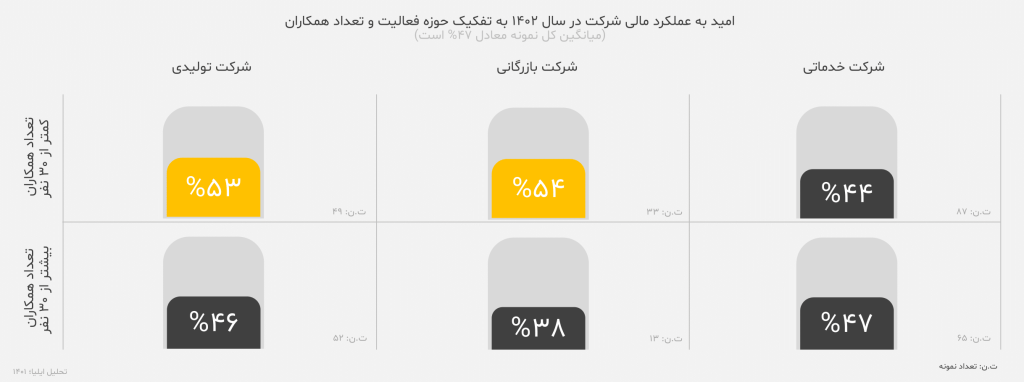
47% of CEOs hope for growth in their organization’s financial performance in 1402 and have predicted relative or high growth for the company. However, 40% of managers participating in the current survey have predicted a decline (relative or high) in their organization’s financial performance in the coming year.
Smaller trading and manufacturing companies have the most hope for growth in corporate financial performance.
The most important concerns of CEOs and the fundamental problems of companies
Political and economic instability, liquidity issues, and instability in government laws and regulations are among the most important concerns of CEOs.
By examining the differences in concerns between CEOs under and over 40, it was found that although economic and political instability is the first concern of CEOs, regardless of their age, CEOs under 40 have a strong concern about Internet-related issues and the issue of filtering. The second concern of CEOs over 40 is the lack of liquidity for growth, while this issue is the third concern of CEOs under 40.
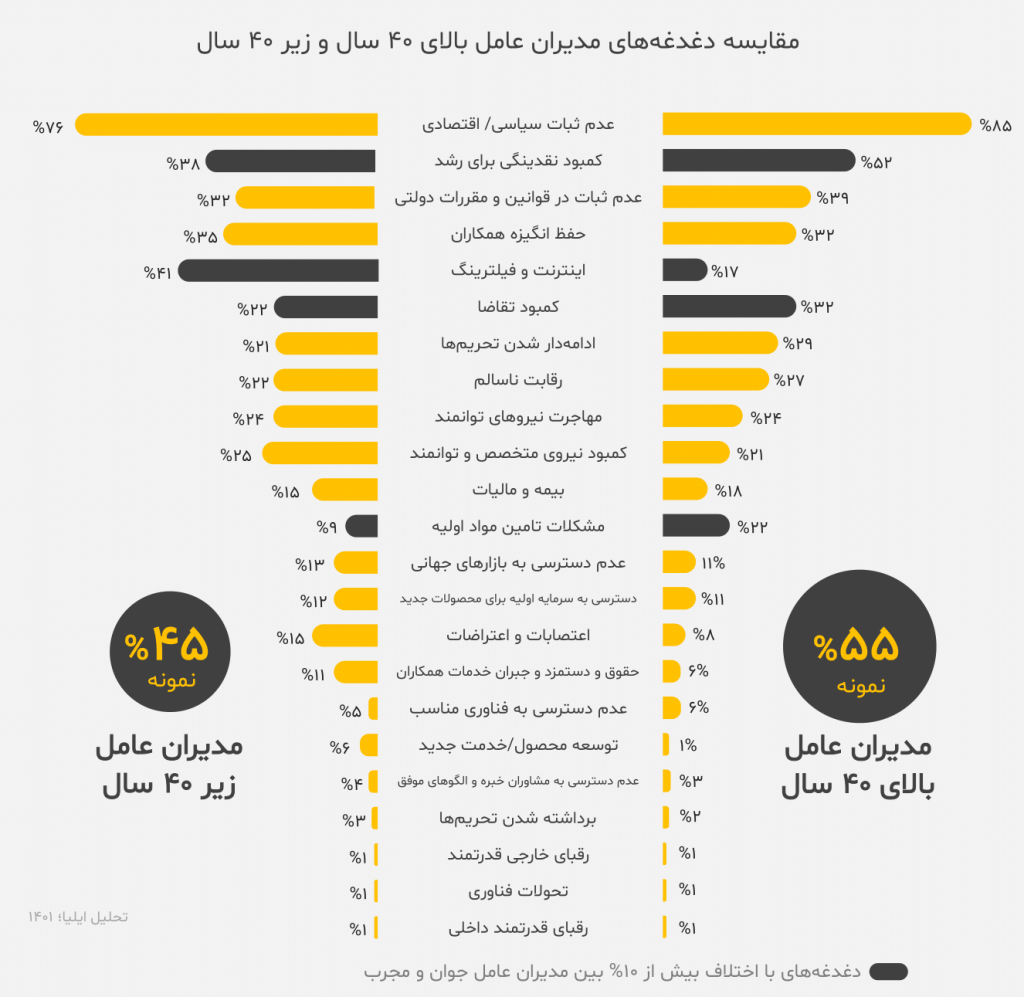
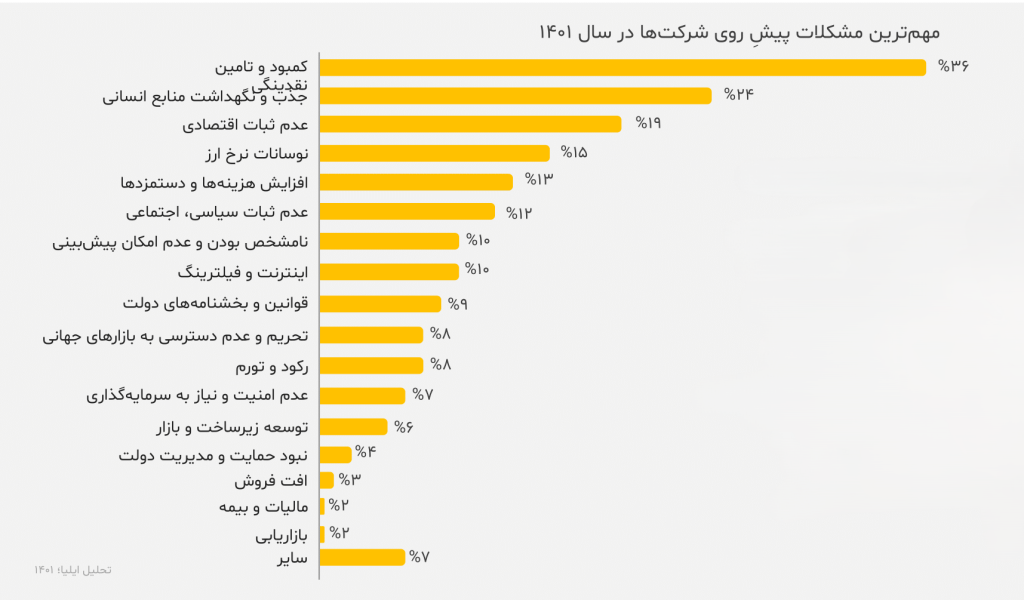
The second main concern of CEOs in large service companies is employee motivation and issues related to the Internet and filtering. This is while none of the semi-private companies are concerned about the Internet and filtering. On the other hand, the most important problems of companies in 1401, according to CEOs, were issues related to the shortage and provision of liquidity, problems related to attracting and retaining human resources, instability and fluctuations in the exchange rate, among other frequent problems of companies.
CEOs’ programs and areas of focus
65% of CEOs surveyed said that their average focus on the state of their company this year has been on current and operational issues. Smaller businesses are more likely than others to be focused on current and operational issues.
CEOs’ lifestyle and work style
CEO Lifestyle
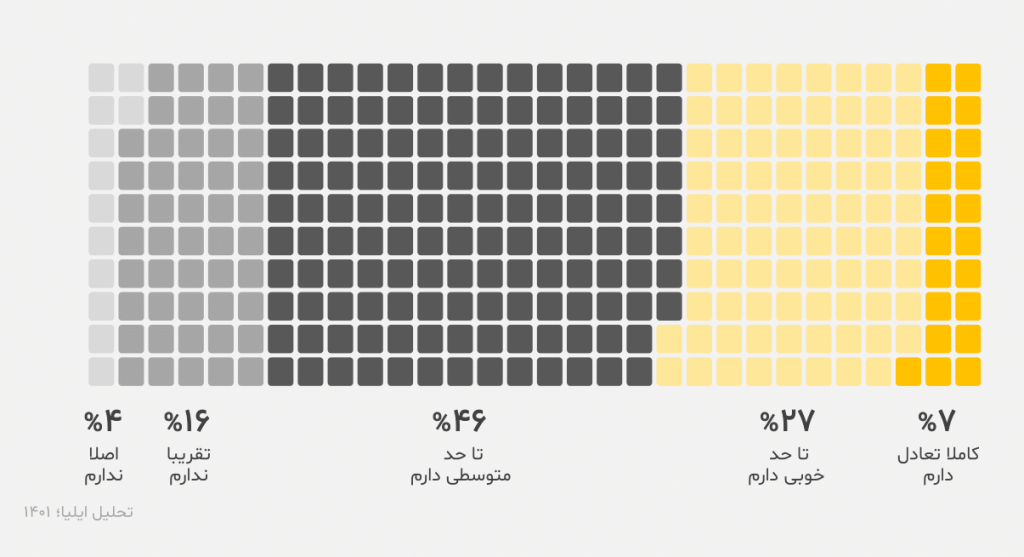
We may have often wondered whether we work to live or live to work, but this question is of little importance to CEOs. Although work-life balance and the trade-offs between them have always been a challenge for busy executives, many concerns make it difficult for CEOs to maintain work-life balance. About 34 percent of CEOs experience good work-life balance. And only 7 percent reported perfect work-life balance.
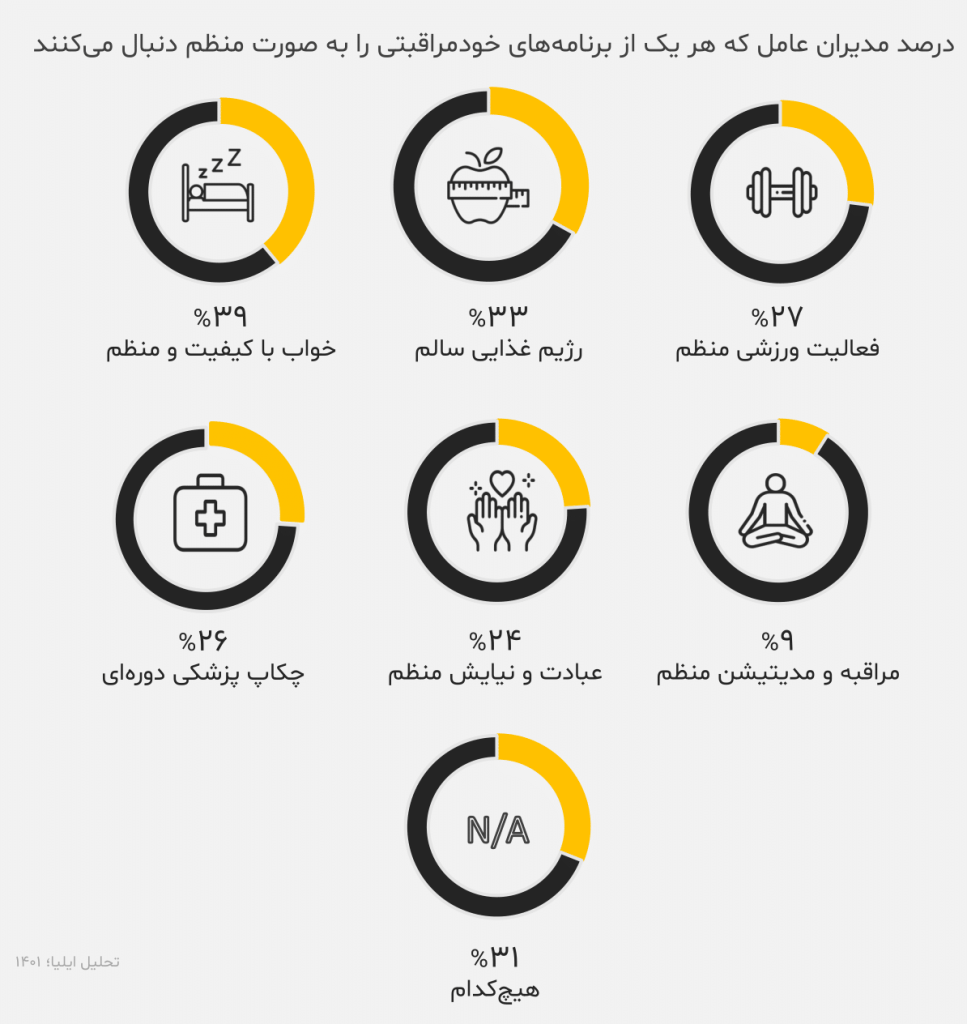
Due to the heavy workload and high responsibility, the job of CEOs is often ranked among the most stressful jobs. Among the 300 CEOs in this survey, more than half of the CEOs face a lot of stress on a daily or weekly basis. The number of managers who experience stress on a monthly basis is also not negligible. 22% of CEOs have admitted that they face severe stress once or twice a month. Getting adequate and quality sleep as one of the most important self-care programs is listed as a regular program by only less than 40% of CEOs. Although 70% of CEOs include at least one self-care program in their schedules on a regular basis, this number was reported to be about 85% in 2017.
Professional services used by CEOs
CEOs use a variety of methods and services for personal development and business growth. Using a business coach and consultant, using sports and fitness services, psychological services, and health and nutrition consultants are among the topics examined in this study.
About 20% of CEOs currently use the services of a business consultant in various fields. Also, 17% of CEOs use regular exercise services for self-care.
10% of CEOs benefit from specialized health services such as psychologists and psychoanalysts. It is worth noting that the use of personal coaching and health and nutrition consultants is not very common among managers.
About 42 percent of executives surveyed do not use any of the common professional services on a regular basis.
CEOs’ perspective on digital transformation
“If digital transformation was more like an ‘opportunity’ before the coronavirus pandemic, during this period and beyond, it has become a Obligation and survival factor “It has become a thing for all industries.”
Mehdi Shami Zanjani – Faculty Member, University of Tehran
The goal of digital transformation is not just to digitize the organization. Rather, the goal is to create value for the business through the implementation of digital transformation. To create value, the organization needs a roadmap. In this regard, 21% of CEOs have admitted that in addition to implementing digital transformation based on a predetermined strategy, they have also identified and analyzed the values obtained from the implementation.
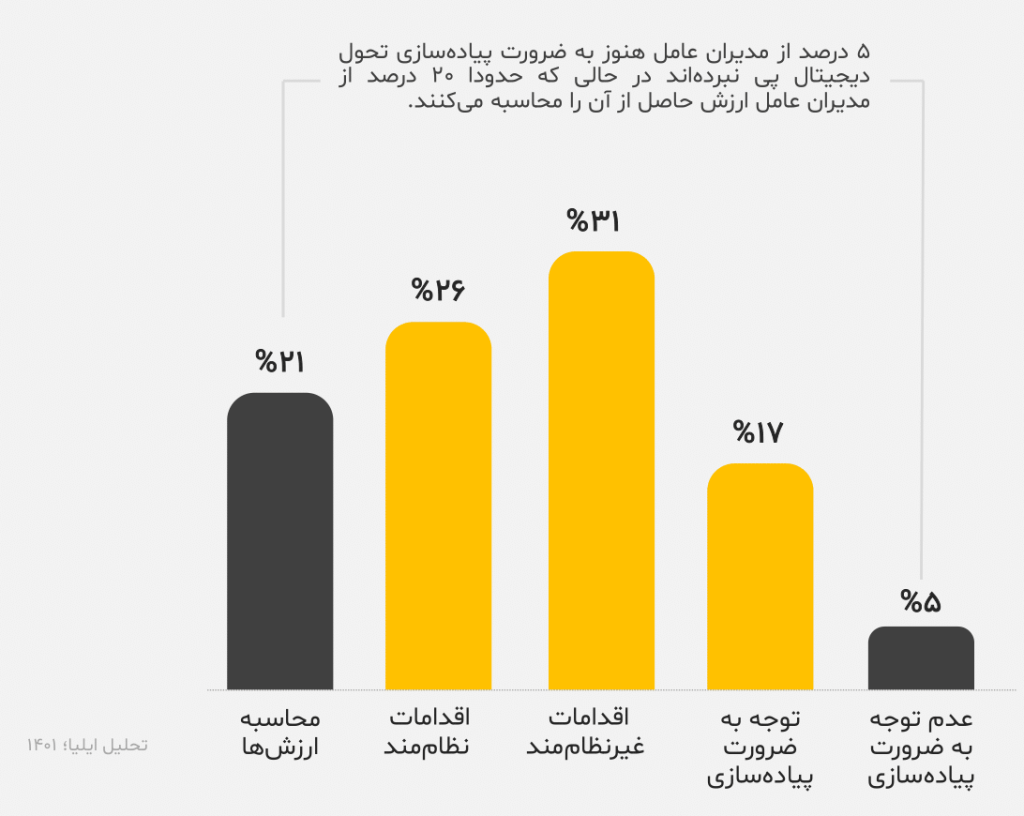
Leveraging disruptive technologies brings numerous benefits to organizations of all sizes and backgrounds. After artificial intelligence, CEOs will be more inclined to embrace the Internet of Things and 5G and reap the benefits of these technologies.
The most important priority for CEOs in the digital age
In implementing digital transformation, various dimensions of the organization undergo changes. Among these dimensions, we can mention the business model and business processes. Implementing digital transformation requires a change in the business model. Therefore, tasks in organizations will be performed in a different way compared to the past.
According to the survey, 41 percent of CEOs believe that changing the business model is the top priority for implementing digital transformation. After that, business processes are the second priority for CEOs to implement changes. Only 6 percent of CEOs are focused on improving the employee experience.
Barriers to Successful Implementation of Digital Transformation
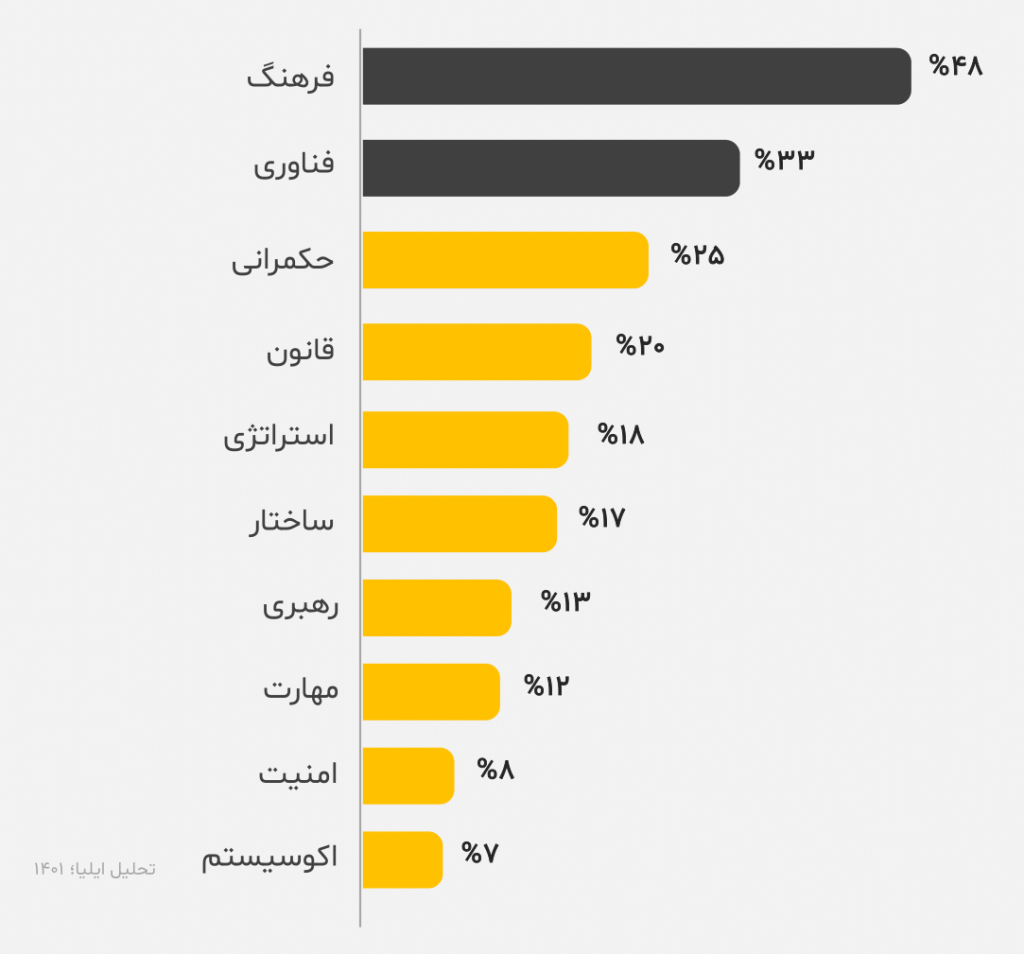
Although various issues such as strategy and roadmap development must be considered in implementing digital transformation, it is important to note that an organization needs a strong and shared culture to successfully implement everything it has developed.
Nearly half of CEOs say their biggest bottleneck in implementing digital transformation is organizational culture, followed by 33 percent who believe technology is another major bottleneck in implementing digital transformation in their organization.
Summarizing the results and presenting the problem to the audience
Overall, the report’s findings can be summarized into six issues for CEOs and two issues relevant to policymakers and business decision-makers. In the fifth section of the report, issues are raised to deepen the audience’s view of these issues and provide a start on the path to improving these outcomes.
Problem-solving from the report findings for CEOs
Liquidity shortage and supply: In these circumstances, what measures can CEOs take to create and manage liquidity? Which cost-cutting policies will work for companies? How is it possible to provide new services or products with the aim of strengthening liquidity? What solutions do management consulting firms have to solve problems related to liquidity management? How can CEOs use the financial facilities of funds and financial and banking institutions?
Current issues versus business growth and development: The importance of this finding for CEOs is associated with raising these issues: How can they better manage their time during workdays? Is there a suitable solution for delegating daily tasks to an executive vice president or COO in the company? What consequences and risks will excessive focus by CEOs on current issues of the organization have for the company’s growth? Has the severity of this risk and its consequences been seen and properly understood by CEOs? If CEOs are involved in daily operations in the organization, who or what units in the company are thinking about development and the future? Isn’t creating such units with a research and development and future-oriented perspective part of the company’s requirements?
Maintaining the motivation of colleagues: Questions that can be raised in the position of a CEO in Iran: What mechanisms can be used to maintain the motivation of existing colleagues? To what extent can CEOs play this role well in the specific macro-environmental conditions of Iran? On the other hand, what consequences or risks will special attention to maintaining existing colleagues entail? How much intellectual and business potential will be lost due to organizations’ preoccupation with this issue?
Self-care and attention to CEO health: Questions that can be studied and explored further in the future: How can CEOs live healthier lives? What self-care practices are most appropriate for each CEO? How can these services be repeated as regular habits? What is the role of a personal consultant, coach, or coach in strengthening CEO self-care?
Familiarity with the requirements of the digital age and dependence on implementing digital transformation: Is the potential of digital transformation to solve organizations’ problems and improve their conditions well understood? How can the experiences and lessons learned from other companies be used in this regard?
Proposing issues from the report’s findings for policymakers and decision-makers in the economic and business fields
Decreased optimism about the macro business environment and improved corporate performance: Questions that can be raised from this finding: How can the hope and optimism of CEOs – who are the helmsmen for the country’s economic growth and development – be improved by adopting better decisions and policies at the macro level? Is the current situation likely to continue in this way or does it require fundamental reforms?
Internet restrictions and filtering: These questions can be asked: How can safe and secure conditions be provided for businesses to access the free flow of information and the global Internet? Are the risks and economic and psychological consequences of these restrictions on businesses properly understood? Can accurate and correct alternative programs address these concerns? Are representatives from non-governmental companies involved in these decisions so that all sides of the issue are seen?
Using unofficial information and news sources: But the questions that arise are: Is there a serious determination to repair this distrust? What consequences and risks of various dimensions will this distrust of the country’s official media have for the country? Is there a correct understanding of these consequences? Are there operational solutions to repair this relationship between the state-owned media and the CEOs of the non-governmental sector?